



Revision is one of the most important parts of exam preparation, yet it is also one of the most misunderstood. Many students believe that repeatedly reading their notes is enough to remember everything. Unfortunately, that’s not how the brain works. If you’ve ever studied a chapter thoroughly only to forget it during the exam, you’re not alone.
The good news is that neuroscience has helped us understand how the brain learns and stores information. By using scientifically proven revision techniques, you can remember concepts for longer, recall them more easily during exams, and improve your overall performance.
In this guide, we’ll explore how effective revision works and practical strategies that can help students preparing for CBSE, ICSE, and ISC board exams.
How Does the Brain Learn?

Whenever you learn something new, your brain creates connections between nerve cells called neurons. These connections become stronger every time you actively use or recall the information.
Simply reading a chapter once creates weak neural connections. However, revising, practising questions, explaining concepts, and testing yourself repeatedly strengthen these pathways, making it easier to retrieve information when you need it.
This is why revision isn’t about studying the same content repeatedly—it’s about strengthening your memory.
Why Do We Forget?
German psychologist Hermann Ebbinghaus discovered what is now known as the Forgetting Curve. According to his research, we forget a significant portion of newly learned information within a few days if we don’t review it.
The solution isn’t to spend more hours studying. Instead, you should revise at regular intervals. Every revision session strengthens your memory and slows down forgetting.
That’s why students who revise consistently often outperform those who study intensively just before the exam.
Active Recall: The Most Powerful Revision Technique
One of the biggest mistakes students make is rereading notes repeatedly. Although it feels productive, it creates only a false sense of confidence.
A far better approach is Active Recall, where you try to remember information without looking at your notes.
You can practise Active Recall by:
- Solving questions without referring to the textbook.
- Writing down everything you remember about a topic.
- Using flashcards.
- Teaching the concept to someone else.
- Answering previous year questions from memory.
The harder your brain works to retrieve information, the stronger your memory becomes.
Use Spaced Repetition Instead of Last-Minute Cramming
Cramming may help you remember information for a day, but it rarely leads to long-term learning.
Spaced Repetition involves revising the same topic at increasing intervals. For example:
- First revision within 24 hours.
- Second revision after one week.
- Third revision after two weeks.
- Final revision before the examination.
This method helps your brain transfer information into long-term memory and reduces the chances of forgetting important concepts.
Practice Questions Are Better Than Passive Reading
Your brain remembers information more effectively when it is forced to apply knowledge rather than simply recognise it.
That’s why solving previous year question papers and sample papers is one of the most effective revision methods. It not only improves memory but also familiarises you with the exam pattern, time management, and frequently asked question types.
Students preparing for board exams can use BoardsDaddy to access official previous year question papers, sample papers, and other study resources in one place. This allows you to build a structured revision routine without spending time searching across multiple websites.
Make Short Revision Notes
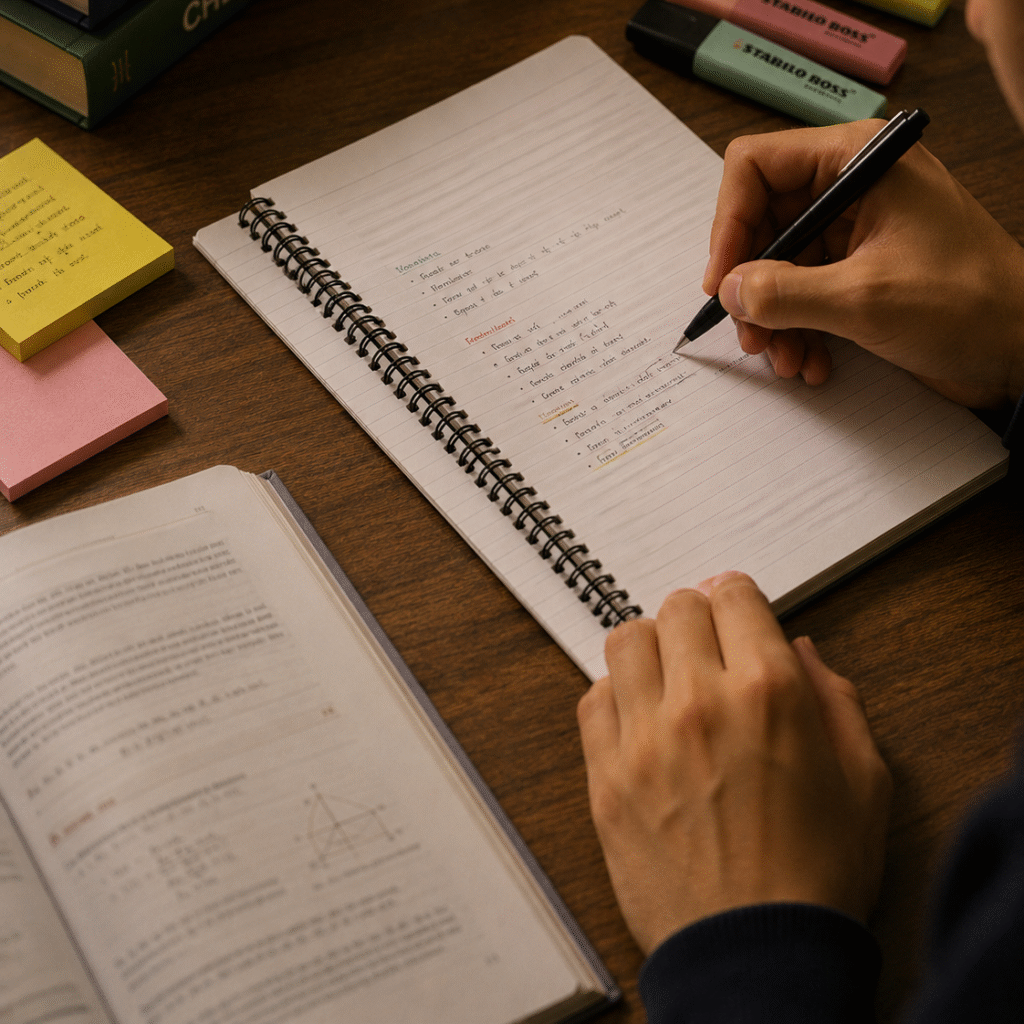
As exams approach, reading entire textbooks becomes difficult.
Instead, prepare concise revision material containing:
- Formula sheets
- Important definitions
- Flowcharts
- Mind maps
- Key diagrams
- Important reactions and equations
These quick-reference notes make final revision faster and more effective.
Sleep Is Part of Revision
Many students sacrifice sleep to study longer, believing it improves performance. In reality, sleep plays a vital role in memory consolidation.
During sleep, the brain processes and stores the information learned during the day. Students who get 7–8 hours of quality sleep generally remember concepts better than those who stay awake all night.
Studying smarter always beats studying longer.
Learn from Your Mistakes
Revision isn’t only about revisiting what you know—it’s also about identifying what you don’t know.
Maintain an “Error Notebook” where you write down:
- Frequently forgotten formulas
- Incorrect answers
- Weak chapters
- Common calculation mistakes
Reviewing these errors regularly ensures that the same mistakes don’t appear in your board examination.
How Igniters for Tomorrow Helps Students Overcome This Problem
Many students know what revision techniques they should use, but they still struggle to apply them consistently. This is where Igniters for Tomorrow plays an important role.
Igniters for Tomorrow helps students overcome revision-related problems by focusing on concept clarity, personalised guidance, and structured learning. Instead of relying on rote memorisation, the platform encourages students to understand topics deeply so that revision becomes easier and more meaningful.
Through mentorship, study planning, and evidence-based learning strategies, Igniters for Tomorrow helps students:
- Build stronger conceptual understanding
- Identify weak areas early
- Follow a disciplined revision routine
- Use active recall and practice-based learning effectively
- Reduce exam stress through regular board pattern tests.
Since BoardsDaddy is an initiative of Igniters for Tomorrow, students also benefit from access to official syllabi, previous year question papers, sample papers, and board updates in one place. This combination of resources and mentorship helps students revise more efficiently and avoid the common problem of forgetting what they study.
Build a Scientific Revision Routine
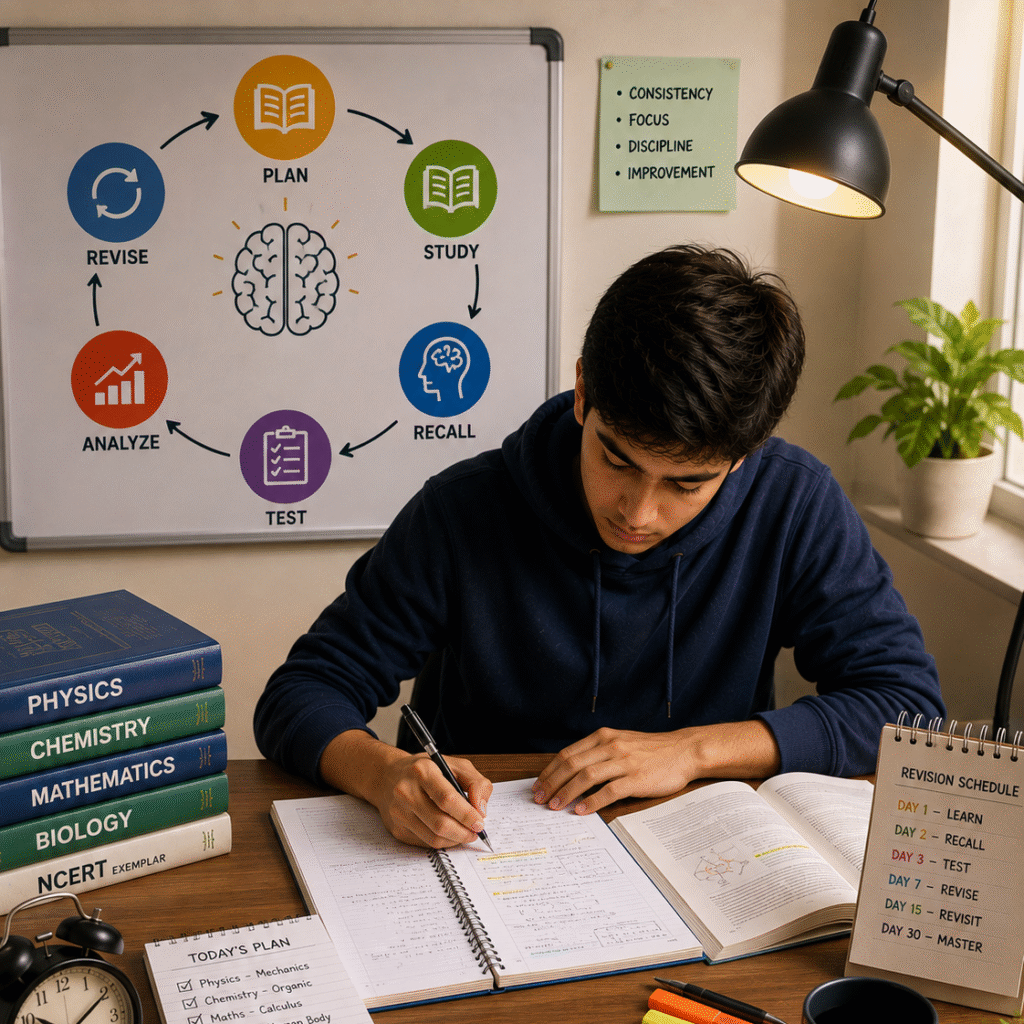
An effective revision plan doesn’t have to be complicated.
A simple daily routine could include:
- Revising one previously studied chapter.
- Learning one new concept.
- Solving 20–30 practice questions.
- Reviewing mistakes from earlier tests.
- Spending a few minutes recalling important formulas or definitions before going to bed.
Small, consistent revision sessions are far more effective than occasional marathon study sessions.
Conclusion
Revision is not about reading the same chapter again and again. It’s about helping your brain strengthen memories through active recall, regular practice, and spaced repetition. By understanding how memory works, students can prepare more efficiently, reduce exam stress, and improve their performance.
Platforms like BoardsDaddy support this process by providing official syllabus, previous year question papers, sample papers, and board updates in one place, making revision more organised and effective. BoardsDaddy is an initiative of Igniters for Tomorrow, an educational platform that focuses on concept-based learning, personalised mentorship, and evidence-based study strategies. Rather than encouraging rote memorisation, Igniters for Tomorrow helps students build strong foundations that prepare them not only for board exams but also for future academic success.
Leave a Reply